Why Is Ethiopia on the Brink of Crisis Again
- Earth
- Africa
- State of war
This was published 1 year ago
'Train crash in slow motion': Why Federal democratic republic of ethiopia is on brink of ceremonious war
Past Cara Anna
Updated
Nairobi, Kenya: Ethiopia is on the brink of civil war, threatening the stability of ane of the world'south most strategic regions, the Horn of Africa, and the fracturing of 1 of the continent'due south virtually powerful and populous countries.
The crunch has been building for months. According to the deputy manager of the International Crisis Grouping's Africa program, Dino Mahtani, "it has been like watching a train crash in dull motion". Now Ethiopia's Prime number Minister Abiy Ahmed, awarded the Nobel Peace Prize final year for sweeping political reforms, faces the sharpest consequences yet of the country'south contempo shifts in power.
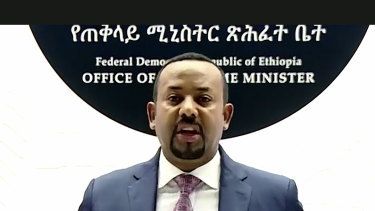
Ethiopian Prime Government minister Abiy Ahmed has ordered air strikes in the Tigray region. Credit:UNTV/AP
Here are key reasons for the international alert:
What happened?
Two things occurred on November 4: Communications were cut in the state's heavily armed northern Tigray region, and Abiy appear he had ordered troops to reply to an alleged deadly assail by Tigray People'due south Liberation Front (TPLF) forces on a military base at that place. Both sides have accused each other of initiating the fighting.
Both stepped up pressure the side by side mean solar day. The army said it was deploying troops from around the country to Tigray and Tigray'south leader appear "we are ready to be martyrs". Casualties were reported on both sides.
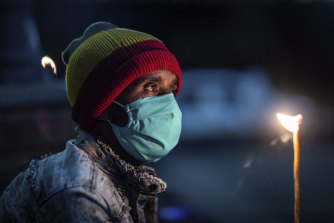
An Orthodox Christian lights a candle every bit people pray for peace in a church service in Addis Ababa, Ethiopia. Credit:AP
Next the Prime Government minister appear his authorities had carried out air strikes in the "first round of operation" against the TPLF, while the Tigray region was increasingly cutting off.
He said the air forcefulness destroyed heavy weapons in Tigray's majuscule, Mekele, and surrounding areas, alleging the TPLF had "the desire to use them".
The functioning would continue, Abiy said, "until the junta is made accountable by police". And he warned the Tigray population: "In lodge to avoid unexpected peril, I advise that you limit grouping movements in cities."
Loading
There was no firsthand response from the Tigray government.
Some experts have compared the confrontation to an inter-country war, with ii large and well-trained forces and lilliputian sign of backing downwardly. Ethiopia is one of Africa's most well-armed nations, and the TPLF dominated Ethiopia's war machine and regime before Abiy took office. It has plenty of disharmonize experience from the years-long edge state of war with Eritrea, next door to the Tigray region, and the International Crisis Group estimates that the TPLF's paramilitary force and local militia have some 250,000 troops.
With communications nonetheless out, it's hard to verify either side's account of events on the footing.
On November 26, Abiy's troops surrounded the regional uppercase for a "final assault" after his 72-hr surrender ultimatum expired.
Fearful of international condemnation, the Ethiopian government has tried to spin the conflict equally a law enforcement operation.
Nonetheless, the Un and Homo Rights Watch have warned of possible war crimes charges if the Ethiopian regular army attacks Mekele.
How did we get hither?
Ethiopia's ruling coalition appointed Abiy as prime minister in 2018 to help calm months of anti-government protests, and he apace won praise — and the Nobel — for opening political space and curbing repressive measures in the state of some 110 one thousand thousand people and scores of ethnic groups. But the TPLF felt increasingly marginalised and last twelvemonth withdrew from the ruling coalition.
The TPLF objects to Ethiopia's delayed election, blamed on the COVID-19 pandemic, and Abiy's extended time in office. In September, the Tigray region voted in a local election the federal government called illegal. The Abiy regime later moved to divert funding from the TPLF executive to local governments, angering the regional leadership.
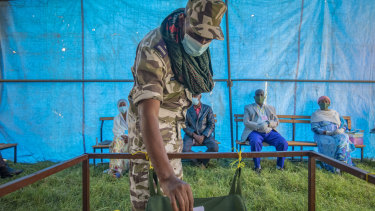
A member of the Tigray Special Forces casts his vote in a local election in the regional capital Mekelle in September. The Ethiopian government alleged the election illegal. Credit:AP
On November 2, Tigray leader Debretsion Gebremichael warned a bloody disharmonize could erupt.
What happens at present?
Debretsion has said that Tigray forces are "gear up to die in defense force of our right to administer our region". The regional government has also mobilised Mekele residents, according to a diplomatic source.
Only a total-calibration set on on the city of more than 300,000 people could lead to the deaths of thousands in punishing urban warfare.
The conflict could as well spread to other parts of Ethiopia, where some regions have been calling for more autonomy, and deadly ethnic violence has led the federal government to restore measures including arresting critics.
Addressing those fears, Ethiopia's deputy army chief Birhanu Jula said of Tigray: "The state of war will end there".
Some governments and experts are urgently calling for dialogue, but a Western diplomat in Addis Ababa, the capital, said "the message from the Ethiopians is, if you talk most a dialogue you equate the two parties, but 'This is a legitimate government, that's a renegade group'." The objective as put forwards by Ethiopia is to shell the TPLF, the diplomat said on condition of anonymity, and "if I say I'one thousand going to crush y'all, so is in that location really scope for any negotiation?"
Abiy'southward office said on November 26 that international intervention was "unwelcome" and countries should stand by until Federal democratic republic of ethiopia asked for help.
The TPLF earlier the fighting said it was non interested in negotiating with the federal government, and it has sought the release of detained leaders as a precondition to talks. An inclusive dialogue must occur, observers say, but a statement by a panel of one-time Usa diplomats and military experts for the U.s.a. Constitute of Peace warned it won't arrive "while many of the country'due south most prominent political leaders remain in prison house".
What consequences for the rest of Africa?
Few regions are more vulnerable than the Horn of Africa. Ethiopia's neighbours include Somalia — Ethiopian forces accept reportedly begun withdrawing from that state to return abode — and Sudan, facing its own huge political transition. Neighbouring Eritrea has shown little sign of opening upwardly later making peace with Ethiopia in 2018, and its government and the Tigray one don't get along.
Observers warn that a conflict could suck in these countries and others not far from the most strategic armed services outpost in Africa, tiny Djibouti, where several global powers including the U.s.a. and Cathay have their only military bases on the continent. The Horn of Africa is also a brusque water crossing away from Yemen and the rest of the Arabian Peninsula.
Federal democratic republic of ethiopia already was drawing business organization over a dispute with Egypt over a huge dam Ethiopia is completing on the Bluish Nile.
While there have been worries about armed forces action, "I would like to retrieve Egypt is a responsible enough role player to realise that fragmentation of Ethiopia is fundamentally so damaging to regional security," former United states diplomat Payton Knopf, a senior advisor with the United States Establish of Peace, said this week.
A region in which Abiy has played high-profile peacemaker is now at risk.
AP, agencies
Source: https://www.smh.com.au/world/africa/train-crash-in-slow-motion-why-ethiopia-is-on-brink-of-civil-war-20201107-p56ccx.html
0 Response to "Why Is Ethiopia on the Brink of Crisis Again"
Post a Comment